Elevating State Management: Embracing the Actor Model in UI Development
Using the actor model for scalable and modular UI state management
In frontend architecture, a paradigm gaining traction is the actor system, a concept rooted in the works of Carl Hewitt from the 1970s. This approach offers a refreshing perspective on state management, transitions, and effects, where components act as independent actors, communicating through messages.
The Actor Model Revisited
The actor model, as conceptualized by Carl Hewitt, introduced the idea of encapsulated entities (actors) that communicate exclusively through messages. Each actor maintains its own state, fostering a decentralized and modular system. This foundational concept has found applications in distributed systems and concurrent programming.
Actor Systems in Frontend Development
Frontend development now leverages actor systems to structure applications. Each component acts as an actor, responsible for its state and interactions. This decentralization aligns seamlessly with actor model principles.
Message Passing and State Updates
Actors communicate by sending messages to each other, enabling controlled state updates. This enhances modularity and simplifies understanding of component interactions. A consistent interface ensures uniform state update patterns across actors.
State Charts and Visual Representation
David Khourshid's state charts add a visual dimension to actor systems. They provide intuitive representations of state transitions and interactions, improving the developer experience for complex state scenarios.
What’s New
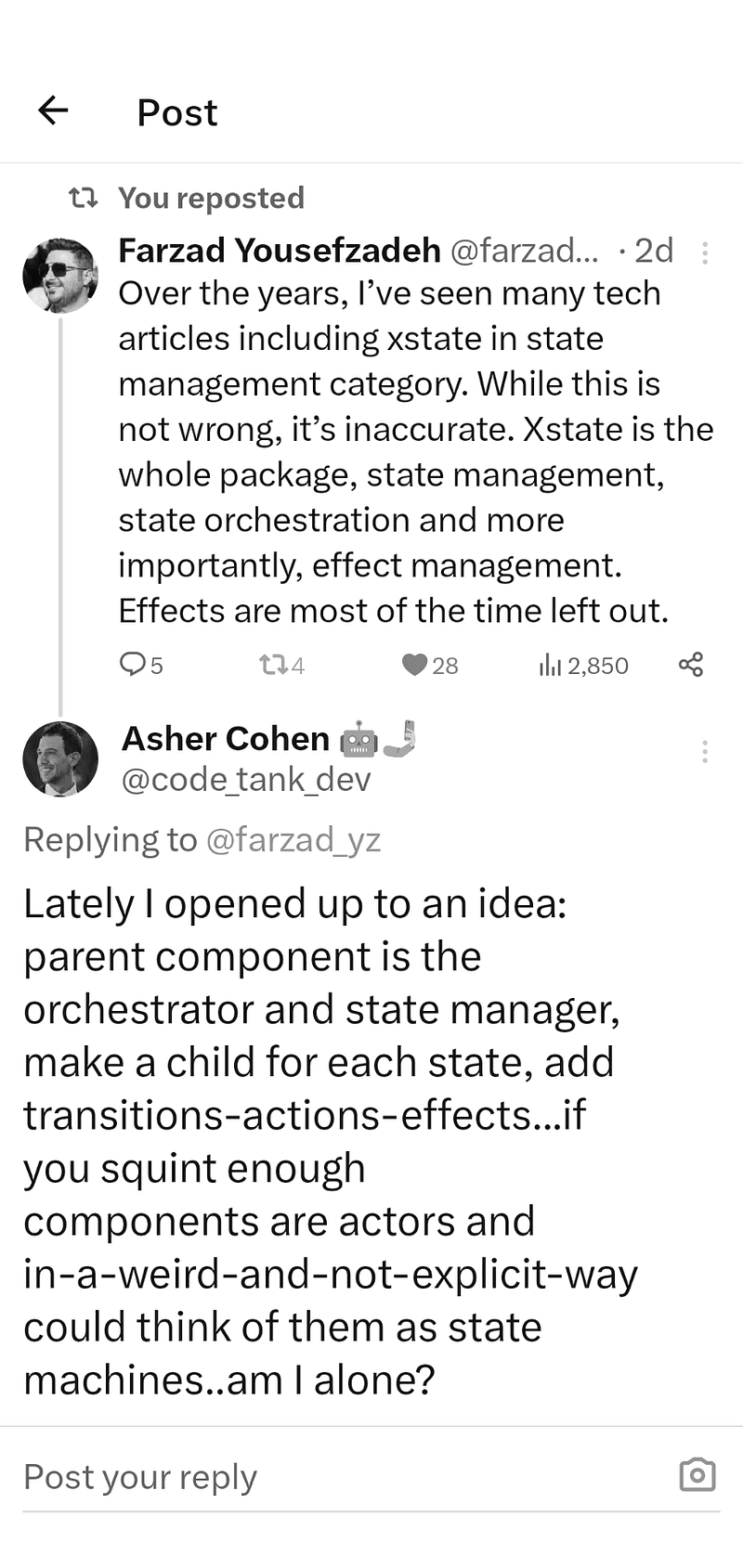
Traditional UI development often emphasizes stateful actors (stores) and mechanics but overlooks effect management. XState offers a comprehensive solution for state, orchestration, and effect management.
Understanding the Actor System
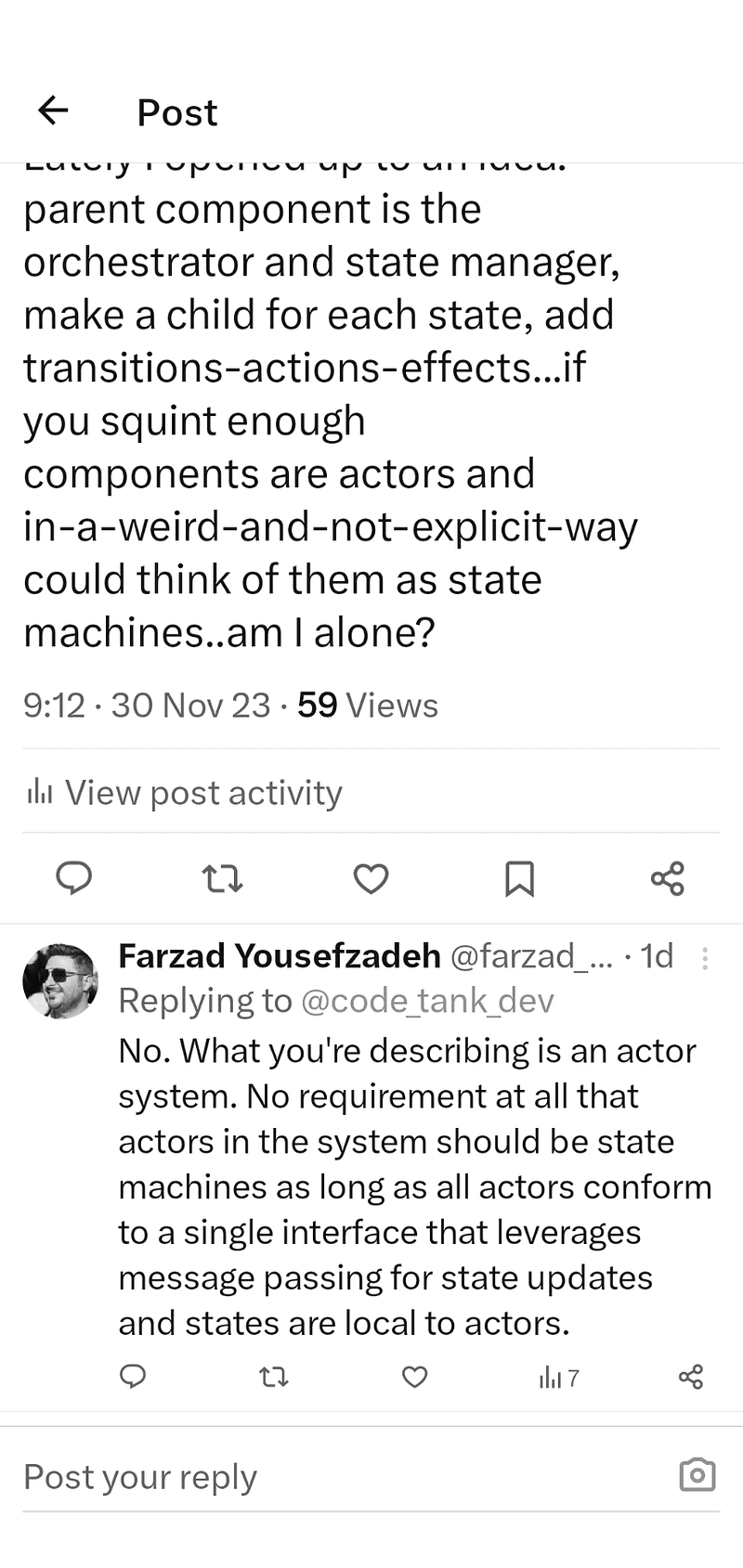
UI components can be redefined as actors encapsulating state, transitions, actions, and effects. Actors follow a unified interface using message passing for state updates. Decentralization allows the parent component to orchestrate and manage state effectively.
The Role of XState
XState facilitates explicit mapping of transitions and effects. It provides a centralized object for defining effects and the relationships between transitions and effects, whether one-to-many, many-to-one, or many-to-many.
Centralization vs. Decentralization
Unlike Redux, which centralizes effects in middleware, actor systems distribute state responsibilities. Each actor becomes self-contained, improving scalability and maintainability while clarifying the origin of dispatched actions.
Embracing Decentralized State
The parent component coordinates communication between actors. States are local to actors, simplifying architecture and improving codebase clarity.
Conclusion
Adopting an actor system in UI development transcends conventional state management. Independent actors with a shared communication protocol offer scalable, modular solutions. XState complements this model with explicit transitions and effect management, enabling dynamic and responsive user interfaces.
In advancing UI development, focus shifts from merely managing state to orchestrating a well-choreographed performance of stateful actors.